Showing posts with label books that lived up to the hype. Show all posts

Saturday, October 13, 2012

What I'm Reading Now-The Immortal Life of Henrietta Lacks

The Immortal Life of Henrietta Lacks by Rebecca Skloot-I don't know what I can say about this book that hasn't already been said. If you've been paying attention at all over the last couple of years, you've heard great thing after great thing, and they're all right. If you haven't been paying attention, Henrietta Lacks was a black woman who had cervical cancer in the 1950s. Her doctor took a sample of some of her cells and sent them off to a lab where they were kept alive and grown in solution, where they continued to reproduce. This was something scientists had been trying to do for years; something about Henrietta's cells were different, and today they are still used around the world for research. Her family had no idea that this was happening. It was by pure coincidence that they found out that part of Henrietta had been kept alive long after she passed away and that her cells had been used to help find the cure for polio, had been shot into space, are still being used for research around the world and are worth hundreds of dollars per vial. Meanwhile, many of the surviving members of her family could not afford the medical care they needed.

Although a few articles have been written about Henrietta in the past, this book finally provided her family with the long-awaited recognition of the woman who made so much scientific progress possible.  It also provides a shocking look at patients' medical rights, past and present. You think that just because something is inside your body it belongs to you? If your cells miraculously develop the cure for cancer on their own, you would be entitled to some kind of royalty from that, right? Heh. Think again. Then find somebody to hug. Because thinking too long about the realities of the world can turn you into a big cynical jerk. And there's no way your body's going to find the cure for cancer with that attitude.

I said at the beginning of this review that I didn't know what else I could say that hasn't already been said, but actually I think I might have something. There were two little things in this book that made me smile when I read them: Henrietta and her cousins saving up money to go see the latest Buck Jones cowboy movies and Dr. Carrel's "immortal chicken heart," a 1912 scientific experiment which inspired the 1937 Lights Out radio program's "Chicken Heart" episode which inspired Bill Cosby's 1966 bit, "Chicken Heart." I grew up listening to Bill Cosby records, and he's the only person I've ever heard mention Buck Jones or Chicken Heart. I had no idea that "Chicken Heart" had its basis in reality! To see Buck Jones and the chicken heart mentioned in this book was like a little wink to my child-hood, but also added another layer to Henrietta's life and times.

So, thank you, Henrietta, for all that you have contributed to science and for reminding me of this great gem:


And here's the original Lights Out episode that inspired it:


I couldn't find the Buck Jones routine, but if you're interested, it's part of the "When I Was a Kid" album.

Here's what some others thought:
Lori L. at she treads softly
Heather J. at Age 30+...A Lifetime of Books
Kailana at The Written World and Michael at Books on the Nightstand both listed it as one of their Best of 2010

Friday, August 10, 2012

What I'm Reading Now--Blood, Bones & Butter: The Inadvertent Educaion of a Reluctant Chef

Blood, Bones & Butter: The Inadvertent Education of a Reluctant Chef by Gabrielle Hamilton--I think I first heard about this book over at Books On The Nightstand. Michael loved it (his review starts at 18:02), and I'm sure I heard or read other good things about it, but every time I thought about adding it to my TBR list, I'd hesitate--I wasn't quite sure if it was something I'd be interested in or not. Well, I finally saw it on display at my library one day and figured I'd check it out. I'm so glad I did--I loved it!

Hamilton is the owner/chef of the restaurant Prune, in New York City, and the book's title pretty much says it all. She never really set out to become a chef, but, in one way or another, she's been training for it for most of her life. The book is broken up into three sections--"Blood," "Bones," and "Butter"--and each has a very different feel.

To break it down roughly, "Blood" is about Hamilton's childhood, who she is, what's in her blood; although she takes a turn toward the dark, depressed delinquent teenager eventually, I love the nostalgic sense of family that she portrays early on. Her father was a set designer for the Ringling Bros. and Barnum and Bailey Circus and "[p]rying back the lid on a fifty-gallon barrel of silver glitter--the kind of barrel that took two men and a hand truck to wheel into the paint supply room of the shop--and then shoving your hands down into it up to your elbows is an experience that will secure the idea in your heart for the rest of your life that your dad is, himself, the greatest show on earth."(p.9) Michael said that he often found himself with a big smile on his face while reading this book, and I felt the same way, especially during this part.

"Bones" is about Hamilton's adult journey to becoming a restaurateur (and includes, among other things, what I think is a highly useful take on balancing family and work life.) The magical childhood has, sadly, lost most of its magic, but we start to see other influences in her life. Although she doesn't realize it at the time, Hamilton's travels abroad are preparing her for her future position as a supplier of food, comfort, warmth, and welcome. Also, there is a great/horrific story about a rat. If you have ever thought about opening a restaurant because it would be "fun" you should read this book. There is a lot of blood, sweat, and tears involved in getting a restaurant up and running and keeping it going every. single. day. If you don't think you have to be tough to open up and run a restaurant, think again.

"Butter" is largely about summers spent in Italy, cooking in the kitchen with her Italian mother-in-law, a woman who does not speak a word of English, but speaks the language of cooking and family and love. This comes back to family again, but with another feel yet again, this time with a realization of things that are slipping away.

I mentioned that I first heard about this from Michael over at Books on the Nightstand, but Michael mentioned it again (review begins at 20:52) when it came out in paperback...with a new chapter! Dang-I read the hardback; I would totally like to get my hands on the paperback because I definitely wanted some follow-up on a few things.

If you have reviewed this book, let me know, and I'd be happy to link to your review. I'd like to hear what other books have inspired people to cook. Books like this make me think, Yeah, I could do that! I could totally make my own pasta and use eggs to make things rich and savory instead of icky and egg-tasting. I'm going to start growing all my own vegetables and plant olive trees and become familiar with an actual butcher and raise chickens and stuff!

And finally, you know how I love my coincidental literature bits, and I have some for this book. Not too long after I finished reading this, I was on line looking for information about my tomatoes that were turning black (blossom end rot, as it turns out), and I found Keavy's 10 pound of onions blog where she talks about cooking all kinds of wonderful looking things (things that look like they have been inspired by Gabrielle Hamilton), and I saw an entry that started out with "Bill and I went to Prune today" and I thought, Hey! That was inspired by Gabrielle Hamilton! Then I clicked around on her blog a little more and found a recent post that starts out, "I've been obsessively reading Blood Bones and Butter by Gabrielle Hamilton of Prune for the last week." Hey! Me too! Well, mine was a month ago, but still. Also, I don't really do eggs, but after reading this book, Eggs Poached in Tomato Sauce is the kind of thing I might get brave and try one of these days.

Friday, July 27, 2012

All The Weirdness I Encountered While Reading The Stand

**Edited 8/26/12--Augh! I just realized how much I suck. I wrote this big ole long..."review" and never even said thanks to Trish for hosting The Stand read-a-long, or the Standalong. So, thanks, Trish!  Please jump over to her blog to see what other readers thought about The Stand. Now, back to your regularly-scheduled programming:

Hi there! Thanks for joining me! When I started writing my review for The Stand, I mentioned that since the story starts around the middle of June, I often found myself reading things on the same day that they were happening in the book (so on June 30th, I'd be reading about the events of June 30th. I call this sort of thing coincidental literature.) I started writing about all the other weird coincidences that I encountered during my reading, and before I realized it, I already had a whole post's worth of stuff but hadn't made any real progress toward any sort of meaningful review. So, I moved that part of my review over here...and now I still have to write my real review...*sigh*

Weird Thing (WT) #1: As Trashcan Man was setting fire to all the oil tankers and fantasizing about watching the fire spread across the country, I had just watched the Waldo Canyon fire blaze closer and closer to my hometown of Colorado Springs, while several other wildfires continued to burn across the West and Mid-West. This drove home the chilling reality of Trashcan Man's "beautiful" fantasy in a way that the book alone couldn't.

WT #2: My aunt lives in Colorado Springs, and during a check-in phone call with her, she mentioned the book Watership Down; a day or two later, I'm reading about Stu trying to escape from the plague center, and he is thinking about Watership Down. "The thing he remembered most from that book was a phrase: 'going tharn,' or just 'tharn.' He understood it at once, because he had seen plenty of tharn animals, and run down a few on the highway. An animal which had gone tharn would crouch in the middle of the road, its ears flattened, watching as a car rushed toward it, unable to move from the certain oncoming death."

WT #3: As Larry and Rita were escaping the oppressive heat in New York and power outages were beginning to sweep the country, a heat wave was stalled out over the eastern United States and millions of people were without power for days due to storm damage.

WT #4: On July 2nd, Mike posted some photos over at Everything Under the Sun. Meanwhile on July 6th, I was reading about Nick Andros, who, ON JULY 2ND, was having this dream: "He was on a high place. The land was spread out below him like a relief map. It was desert land, and the stars above had the mad clarity of altitude. There was a man beside him...no, not a man but the shape of a man. As if the figure had been cut from the fabric of reality and what really stood beside him was a negative man, a black hole in the shape of a man." Whooooaaaa. Does that totally describe Mike's photos or what?

WT #5: My husband had just gone to bed right before I picked up at Nick's dream (above). Right before he went to bed, we had been sitting there talking, we had both stopped to listen, and he said, "Is that rain?" It wasn't...yet; it was the sound of approaching rain-the wind that moves through and rustles the leaves right before the rain hits. Anyway, Hubby was off to bed, and I started reading about Nick and his dream in which he was being tempted by the dark man. He "wanted all the things the black manshape had shown him from this high desert place: cities, women, treasure, power. But most of all he wanted to hear the entrancing sound his fingernails made on his shirt, the tick of a clock in an empty house after midnight, and the secret sound of rain."

WT #6: On his way home from work, Hubby stopped and bought two loaves of bread, a baguette for him and an olive loaf for me. The bakery is an out-of-the-way-for-us place that we don't get to often, and it was one of those things where he got the idea of the  baguette stuck in his mind and was dreaming about toasting it and slathering it in butter and peanut butter for breakfast the next morning. 'Cause we're all about the healthy eating around here. We didn't have any other bread in the house, and he won't eat the olive loaf, so the baguette was his, ALL HIS! He was tired and worn down from work, but he had yummy bread to look forward to in the morning! Later that night, we had to make a last-minute, hurry-up-let's-go-before-they-close grocery store run for some allergy pills or something. Had we been thinking about it, we probably would have bought some bread...oh wait, nevermind, we had two whole loaves at home! We came back, and saw that the sliding screen door was open--no big deal, our dog lets herself in all the time to go lie on her bed in the living room--and then I saw the wrapper on the dog bed. The empty wrapper. The one that had previously housed an entire baguette. Ohhhh nooooo. Hubby gave up and went to bed exhausted, allergy-ridden and defeated; I picked up my book, but I kept thinking about the bread. I probably read for a couple hours but I couldn't really focus--my mind kept wandering off to how disappointing the non-baguette morning was going to be so I finally decided that I could make a loaf of bread. How hard could it be? (It should be noted that I don't think I've ever actually made a loaf of bread, from scratch, start to finish, without the aid of some type of machine. Since Hubby was sleeping, I was trying to keep the noise level down, so I did it all by hand. At one point, I almost went and woke him up just so he could watch the spectacle that was unfolding in the kitchen, but I figured he needed his sleep. Also, I didn't want him to think he was being attacked by a dough monster.) So, dough kneaded and formed into a somewhat respectable loaf shape, I set it out to rise, washed the remaining eight pounds of dough off my hands, cleaned up a little bit, and resumed reading. I picked up where Stu and Frannie were walking home from the first Free Zone meeting; Frannie is tired and emotional and overwhelmed. Stu "held her, patting her back, remembering one time when his Aunt Betty had gotten a crying fit over some bread that didn't rise--"

WT #7: Okay, last one, I promise! I started reading The Stand while my husband was out of town. Then my bedside lamp started turning itself on in the middle of the night. Seriously?? Why does this stuff never happen when he's home? It's one of those lamps you have to touch, so of course my mind immediately jumps to the thought of someone creeping into my room at night while I'm sleeping and touching my lamp. Reading about Flagg's creepy omnipresence right before bed was not making me feel any better! Ghost girl was my next thought since Hubby and I had been talking a couple weeks earlier and realized that we had both experienced the sensation of feeling a little girl presence in the house. We couldn't pin it down exactly, but I think we both experienced it the same night, he in the bedroom and I in the office. Creepy, right? So, I finally braved turning off the light in the daytime (I didn't want to risk it snapping back on in the middle of the night only to reveal some shadowy, red-eyed figure lurking in the corner or, worse yet, standing directly over my bed staring at me!); when it kept coming back on in the middle of the day, I finally decided to leave it. I figured no one was sneaking around my house in the middle of the day turning my lamp on, so I felt better about that, and I didn't want to piss off a ghost.

So, there you have it! All the weirdness I encountered while reading The Stand. Anything weird happen to you?

Tuesday, February 22, 2011

What I'm Reading Now-The Jumbo 2010 Catch-Up Edition, Part IV: Seriously, I Think I'm Done Now


The Guernsey Literary and Potato Peel Pie SocietyThe Guernsey Literary and Potato Peel Pie Society by Mary Ann Shaffer and Annie Barrows-This is one of those books with which  I'm not really sure what to do.  I did enjoy it, let's start there.  I'm always skeptical about books written in epistolary format-the idea of it just doesn't appeal to me.  All the date, time, location, salutation stuff just slows me down.  I can't skim; if it's there, I have to read it.

Here's my real dilemma:  It wasn't that long ago that I read this (four months ago), and while I do remember thinking that it was charming and enjoying reading it (in fact I have a sent email in which I tell someone that I "loved it!"), I could tell you virtually nothing about it now.  This lady goes to this island and visits some people there.  If it weren't for my notes, that would have been your review.  However, I managed to find my notes from when I was reading, and as I was going over them I found myself thinking, Oh yeah, I loved that!  So, do you grade a book based on how much you loved it at the time you read it or how "meh" you feel about it four months later?  

While we all ponder that, I'll share with you some of the things that I liked about the book.

Juliet Ashton lives in post-war London and has reluctantly sold many books, one of which ended up in Dawsey Adams' possession, and he wrote her a letter to let her know how much the book meant to him.  He is a resident of Guernsey, a small island in the English Channel, that is still trying to recover from its war-time occupation.  In her response to him, she says, "Perhaps there is some secret sort of homing instinct in books that brings them to their perfect readers.  How delightful if that were true."  She later says, "That's what I love about reading:  one tiny thing will interest you in a book, and that tiny thing will lead you onto another book, and another bit there will lead you onto a third book.  It's geometrically progressive--all with no end in sight, and for no other reason than sheer enjoyment."  Ah!  Didn't I just say the same thing in my review of Flower Confidential?

In another of Dawsey's letters to Juliet, he says, "Some of the things being sent to us are wrapped up in old newspaper and magazine pages.  My friend Clovis and I smooth them out and take them home to read--then we give them to neighbors who, like us, are eager for any news of the outside world in the past five years.  Not just any news or pictures:  Mrs. Saussey wants to see recipes; Mme. LePell wants fashion papers (she is a dressmaker); Mr. Brouard reads Obituaries (he has his hopes, but won't say who); Claudia Rainey is looking for pictures of Ronald Colman; Mr. Tourtelle wants to see Beauty Queens in bathing dress; and my friend Isola likes to read about weddings."  I love this way of depicting a village.

Juliet is an author and after corresponding with Dawsey for a while has taken great interest in hearing about the Guernsey Literary and Potato Peel Society and has asked Dawsey if, on her behalf, he would solicit his neighbors for their stories about the society.  In her letter, Mrs. Maugery tells Juliet, "Dawsey Adams has just been to call on me.  I have never seen him as pleased with anything as he is with your gift and letter.  He was so busy convincing me to write to you by the next post that he forgot to be shy.  I don't believe he is aware of it, but Dawsey has a rare gift for persuasion--he never asks for anything for himself, so everyone is eager to do what he asks for others."  What a lovely thing to have someone like that in your life!

You can see what I mean about this book being charming, no?  In addition to the charm, there is also a lot of wit, particularly from Juliet.

In Juliet's letter to her friend, Sophie:  "Do you remember that afternoon in Leeds when we speculated on the possible reasons why Markham V. Reynolds, Junior, was obliged to remain a man of mystery?  It's very disappointing, but we were completely wrong.  He's not married.  He's certainly not bashful.  He doesn't have a disfiguring scar that causes him to shun daylight.  He doesn't seem to be a werewolf (no fur on his knuckles, anyway).  And he's not a Nazi on the lam (he'd have an accent)."  I love that the natural progression of speculation goes:  married, bashful, disfigured, werewolf, Nazi.

And again in a letter to her publisher/friend, Sidney:  "He's an expert on Wilkie Collins, of all things.  Did you know that Wilkie Collins maintained two separate households with two separate mistresses and two sets of children?  The scheduling difficulties must have been shocking.  No wonder he took laudanum."

In response to her friend Sophie's poor attempt at snooping:  "Am I in love with him?  What kind of a question is that?  It's a tuba among the flutes, and I expect better of you.  The first rule of snooping is to come at it sideways--when you began writing me dizzy letters about Alexander, I didn't ask if you were in love with him, I asked what his favorite animal was.  And your answer told me everything I needed to know about him--how many men would admit that they loved ducks?"

The other thing that I liked about this book is that it was so clearly written by people who love books--there's a bit about a broken engagement that any true book-lover would understand and non-book-lovers would just think is crazy.  The book as a whole was a bit reminiscent of 84, Charring Cross Road, which I loved for many of the same reasons that I loved this book.  There!  I said it!  See, we just had to come at this sideways, like Juliet said!  Characters who love books, people far away connecting with and helping each other, good humor, it's all there.  So, if you're one of the 12 people out there who still hasn't read this, go read it.  You'll love it!

Well, you can see why this book got its own post, but if you haven't yet checked out The Jumbo 2010 Catch-Up Edition, parts I, II, and III, don't be intimidated.  They're not all this bad, and the one that is talks a lot about Valentine's Day, so you can skip that part.

Thursday, November 18, 2010

What I'm Reading Now-Little Bee

Little Bee: A Novel
Little Bee: A Novel by Chris Cleave-If you're aware of this book, then you're probably aware of the mystique surrounding it.  Maybe mystique is too strong, a word, but the author or publisher or somebody essentially decided to part with the standard practice of telling readers what the book is about; instead, they decided to say:


We don't want to tell you WHAT HAPPENS in this book.
It is a truly SPECIAL STORY and we dont' want to spoil it.
[...]
Once you have read it, you'll want to tell your friends about it.  When you do, please don't tell them what happens.  The magic is in how the story unfolds.


Was Don Draper involved in this?  Because, I have to say, I kind of think this is marketing genius, not to  mention just a little bit ballsy.  I mean, you have to be pretty sure you have a good product if you're going to go with the word-of-mouth marketing ploy, especially with a book.  It seems to have paid off-I've heard nothing but good things, and I did manage to go this long without knowing what the book is actually about, so who am I to part with tradition at this point?

I won't tell you what the book is about, but I will share with you a few parts that I liked.  Early on, Little Bee gives a great example of how different the same language can be between two speakers.

I am only alive at all because I learned the Queen's English.  Maybe you are thinking, that isn't so hard.  After all, English is the official language of my country, Nigeria.  Yes, but the trouble is that back home we speak it so much better than you.  To talk the Queen's English, I had to forget all the best tricks of my mother tongue.  For example, the Queen could never say, There was plenty wahala, that girl done use her bottom power to engage my number one son and anyone could see she would end in the bad bush.  Instead the Queen must say, My late daughter-in-law used her feminine charms to become engaged to my heir, and one might have foreseen that it wouldn't end well.  It is all a little sad, don't you think?  Learning the Queen's English is like scrubbing off the bright red varnish from your toenails, the morning after a dance.
 
I love her view of her language, and this example made me laugh because it reminded me a lot of the pidgin that is spoken here.  I liked Little Bee's view on a lot of things.

On the girl's brown legs there were many small white scars.  I was thinking, Do those scars cover the whole of you, like the stars and the moons on your dress?  I thought that would be pretty too, and I ask you right here please to agree with me that a scar is never ugly.  That is what the scar makers want us to think.  But you and I, we must make an agreement to defy them.  We must see all scars as beauty.  Okay?  This will be our secret.  Because take it from me, a scar does not form on the dying.  A scar means, I survived.

Obviously, Little Bee is referring to scars resulting from violence, but this made me think of the scars left behind by things like cancer, scars that people might try to hide because they think they are ugly or embarrassing and my hope is that everyone with such a scar can adopt Little Bee's philosophy on beauty and strength.

One of Little Bee's habits is to figure out how she would kill herself in any given location.  This sounds morose, but she has her reasons, and I had to laugh at some of her solutions.

One day [they] gave all of us a copy of a book called LIFE IN THE UNITED KINGDOM.  It explains the history of your country and how to fit in.  I planned how I would kill myself in the time of Churchill (stand under bombs), Victoria (throw myself under a horse), and Henry the Eighth (marry Henry the Eighth).  

I had to read the following passage a couple of times before I finally read it correctly.

Everything was happiness and singing when I was a little girl.  There was plenty of time for it.  We did not have hurry.   

I kept thinking that there had been a typo and it was supposed to be, We did not have to hurry or perhaps, We did not hurry.  The addition or subtraction of just one tiny word makes such a huge difference, and I think it's this kind of nuance throughout the book that makes it so successful.

So, overall, I'm on board with everyone else who read and loved this book...but with one caveat.  Little Bee's story is entwined with a woman named Sarah, and for me their story worked well.  The problem for me came anytime the men in Sarah's life entered the picture.  I don't know if Sarah's one of those people who is just attracted to complete losers or if these men were simply caught up in situations for which they found themselves unprepared, and as a result didn't act as well as they could have, but I found their handling of certain situations to be not only distasteful but just downright unbelievable at times.  I suppose that both men could be said to be representative of certain failings in society, and maybe that was the author's intent, but they both just made me want to throw the book at a wall a few times.  Gah

I don't know if Heather J.'s was the first review I saw for this book, but, according to my notes, it does seem to be the one that finally made me get off the fence and decide that I wanted to read this book.  So, thanks Heather!

Other reviews (Warning:  The more you read, the more you are going to know about this story!):

Trish at Hey Lady!  Whatcha Readin'? gives a few more details about the story here.
Florinda at The Three R's Blog was not impressed by the withholding of information about this book.  How do you feel?
Raych at books i done read had some mixed feelings but mostly loved it.
According to Books on the Nightstand listeners and readers, Little Bee was one of the top books of 2009.
In a guest post at My Friend Amy, Mary Sharratt thinks that Little Bee would have been considered women's fiction and thus not taken as seriously had it been written by a woman.  Interesting.  Is she right?
Sheila at Book Journey read this for her book club.  Although the club as a whole didn't love the book, Sheila says, "While it was not the book I thought I was going to be reading, it was the book I was meant to read." You gotta love it when that happens!
Bellezza at Dolce Bellezza says, "There is nothing like a book such as this to point out to me my incredible naivety."  Indeed.  

I'm sure there are plenty of other reviews out there.  If you've reviewed this book, let me know and I'll add a link to your review.

Saturday, May 29, 2010

What I'm Reading Now-Catching Fire

Catching Fire (The Second Book of the Hunger Games)Catching Fire by Suzanne Collins-When I reviewed The Hunger Games last June, I said I would be reading Catching Fire "soon." Does almost exactly one year later count as soon?  Oh, well, I read it, and that's what counts.  I enjoyed The Hunger Games, but I think I liked Catching Fire better. I'm not sure if it's because I didn't read all the hype leading up to it like I did with THG and, therefore, did not have any unmet expectations or if it was because I just couldn't figure out what could be as bad as Katniss and Peeta having to participate in the Hunger Games. They won, they made it back home, they are guaranteed a life of relative prosperity and peace. What could happen? Oh, lots of things, as it turns out!

The one tiny complaint that I have about these books is that Katniss strikes me as being so obtuse at times.  She can think on her feet and assess these crazy life-or-death situations, but she doesn't seem to be able to put two and two together when it comes to other things (like the fact that Gale and/or Peeta might actually have feeeelings for her).  I can't really say more than that because the particular example I'm thinking of would give a lot away...so much in fact, that Katniss should have figured it out by the time she had all this information!  I don't know.  Maybe I'm being too hard on the girl.  Maybe if I were sixteen and fighting for my life and constantly worrying about the fate of my family, I would miss the more subtle stuff too.  What do you think?  Am I being too critical of Katniss?  Should I hold my tongue until after I've had to compete in a Hunger Games and then we'll see what I think of her critical thinking abilities?  Is this a plot device that YA authors use to make their readers feel smart because they've managed to figure out something that the main character has yet to see?  Well, it worked.  Being (at least) twice her age and having the luxury of sitting around and reading about all the horrible things going on in Katniss' life from the safety of my couch, I feel way smart having figured out what I figured out...yeah, OK, maybe  I'm being a little hard on her.

Mockingjay (The Final Book of The Hunger Games)Now I find myself in the same dilemma I was in a year ago:  I enjoyed Catching Fire and am looking forward to the final book in the series, Mockingjay (which comes out August 24, 2010), but now I'm worried that it won't be as good as the other two.  While I left THG thinking, What could happen now? I have a pretty good idea of where things are headed now, and I'm worried I won't like reading about it because where I think it's headed is not really my thing.  So far though, Suzanne Collins has not let me down, so I'm staying optimistic.

Other reviews:
Nicole at Linus's Blanket
Sheila at Book Journey
Amy at My Friend Amy
Raych at books i done read
Lori at She Treads Softly
Anna at Diary of an Eccentric

There are a few reviews that I ran across that I didn't include here because they contain what some readers might not consider a spoiler but what I thought was a major spoiler.  I didn't know this thing was coming, so when it happened in the book, I was like, "NOOOOOOOOO!" (actually, I might have said something else, but I won't print that here) and far be it from me to ruin such a horrifying moment for anyone else!

Monday, May 10, 2010

What I'm Reading Now-The Knife of Never Letting Go

The Knife of Never Letting Go: Chaos Walking: Book One (Hardcover)The Knife of Never Letting Go (Chaos Walking:  Book One) by Patrick Ness-Here's what I wrote on Good Reads right after I finished this book:  This is a dark book with some difficult subject matter. I'm tempted to read the next book in the series, but I don't see how things can get any better, and I don't know if I can handle it if it gets any worse. It's not looking good for our hero. Do not read this book if you are already depressed and looking for something to get you out of your funk! 


I think that mostly covers it, but I suppose that doesn't tell you much about the book.  So:  In Todd's hometown, Prentisstown, he is the only boy left in a town of only men.  His birthday is approaching, and when it arrives he will have reached the age of manhood.  He knows there is some rite of passage associated with this, but he doesn't really have any idea what it is, just that once boys become men, they more or less stop talking to the boys in town.


Prentisstown is a settlement on another planet that is very similar to Earth except for one thing, the Noise.   Everyone can hear everyone else's thoughts, and the result is, well, noisy.  Imagine if all the random thoughts you have throughout the day were broadcast out into the world for anyone within hearing distance to pick up.  Animals' thoughts can also be heard, and I like the way that Ness handled this particular part of the story.  Manchee, Todd's dog, thinks about the way you'd expect a dog to think-a lot about food, poo, and squirrels, and not too deeply about any of those-but he's also got that dog sense that makes him able to pull through for Todd in tough situations.  When Todd and Manchee discover a spot of quiet in the swamp one day, Todd finds the lack of noise eerie and isn't sure what to make of it.  He returns home and tells his guardians, Ben and Cillian, about the hole in the noise, and all hell breaks loose.  They send him on the run with some cryptic information and tell him to get far away because the men of Prentisstown will have picked up on this thoughts and will soon be coming for him, and they won't be coming to congratulate him on his strange new find.


Todd and Manchee are on an adventure, but it is fraught with peril and mystery.  Todd finds out that a lot of the things he knew were not what they seemed, and he discovers a lot of dark secrets along the way.  I was thoroughly captivated by the story, but as I said, this is not a light and happy read.  I do have one tiny nit-picky thing, and that is the accents.  Ness tries to employ a...Southern?  Olde English?...?...accent for part of the book, and it was really distracting for me.  There didn't really seem to be any reason for it that I could garner, and I was just irritated with the people who were talking for using archaic clumsy language.  Not their fault, I know, but still...


I know there have been quite a few reviews of this book lately, but according to my notes, I was first convinced by Raych at books i done read and Darren at Bart's Bookshelf.


Other reviews:


Trish at Hey Lady!  Whatcha Readin'? 
Chris at Stuff as Dreams are Made On... 
Nymeth at things mean a lot  


Thursday, April 22, 2010

What I'm Reading Now: The Book Thief

The Book Thief
The Book Thief by Markus Zusak-This is another one of those books that I've been hearing great things about for ages now, but I was still hesitant to pick it up.  Something about it just didn't seem like it was going to be quite what I was looking for, even though it takes place during WWII, even though it's about a girl who loves books.  I need to get over that and start trusting y'all.  I really loved this story and the way it was told.

Liesel Meminger is a child who has just been delivered to her foster parents in Nazi Germany.  She has caught Death's eye on a few occasions-her status as a survivor made her stand out-and Death is our narrator for the duration of her story.  This is a point that you will pick up in almost any review, followed immediately by some form of, "but don't let that turn you off," and rightfully so.  Death as a narrator isn't gimmicky, but it allows for some interesting use of language and perception that might not come off quite right with a "normal" narrator.  In fact, I loved Death's voice.  Death is a story teller who has been around long enough to pick and choose the best descriptions, the most interesting turns of phrases, all while ferrying the souls of those who have passed.  Death, as you might imagine, has a slightly different perspective of the world, often offering little asides like this one about war:

***A SMALL BUT NOTEWORTHY NOTE***
I've seen so many young men
over the years who think they're
running at other young men.
They are not.
They're running at me.

Ah, so true.  And when they come, Death will take them because that's the job, but it will be done with as much care and respect as possible.  As you can also imagine, Death's job can be a bit hectic at times, but that doesn't mean he doesn't notice the individual souls in his charge.

He was tall in the bed and...[h]is soul sat up.  It met me.  Those kinds of souls always do--the best ones.  The ones who rise up and say, "I know who you are and I am ready.  Not that I want to go, of course, but I will come."  Those souls are always light because more of them have been put out.  More of them have already found their way to other places.  

*sniff* (am I the only one who went into the ugly cry in my bathtub when I read that?  I mean, I hope no one else went into the ugly cry in *my* bathtub because that would be creepy, but...never mind...)  So, anyway, Death is a sympathetic narrator, but also objective and to the point, and I loved the writing in this book.  Also, Liesel receives a book from a friend that is about a girl in a tree, complete with illustrations and everything, so you know I liked that! 

Do you have any book finds like this one, ones that you resisted for so long for one reason or another, and when you finally read it you couldn't figure out why you waited so long?  What are some of your "Phew, I'm so glad it lived up to the hype!" books?

Other reviews:
Martha Caldero, Filling My Patch of Sky, and Word Lily all reviewed this book as part of the Social Justice Challenge 
Books on the Nightstand (Podcast discussion of this book starts at 8:08)

Thursday, January 28, 2010

What I'm Reading Now-The Pillars of the Earth

The Pillars of the Earth (Deluxe Edition) (Oprah's Book Club) Pillars of the Earth by Ken Follett-All I really knew was that this was about a guy building a cathedral, but the cathedral is just the backdrop to so much more! I really enjoyed this look at life in medieval England and all the Spy-vs-Spy shenanigans carried out between the nobility and the church and even between the church and the church. I'm not usually much of a history buff-names and titles and locations and battles and politics and whatnot-and there was plenty of that in this story, but I just kept some notes on who everyone was and the basic quarrels that they had with each other, and that helped keep things straight throughout the book. It was never overwhelming or belaboured, and I thoroughly enjoyed the whole thing.
The story spans 51 years in 12th-century England and provides plenty of good guys and bad guys, and, boy, are some of the bad guys bad. There's the aptly-named Bishop Waleran Bigod who is not so much actively evil as he is greedy and power-hungry and willing to wield his power as a man of God to his advantage above all else.  William Hamleigh, on the other hand, is truly a horrific character.  William, who likes to play games of "stone the cat," William who can't get it up unless he can see fear and pain in the eyes of the woman before him, William who uses murder and rape to keep his starving tenants in line, William who, well, you get the picture.

Working on the side of good is Philip, a pious monk who genuinely believes in doing God's work by helping God's people, not by acquiring power and wealth like some people we could mention (I'm lookin' at you, Bishop Waleran).  Philip is smart, kind, and resourceful, and he finds himself in charge of a priory whose church has just burned down.  Luckily, Tom Builder, who has been roaming the country-side looking for work, preferably as master builder on a cathedral, has just arrived on scene.  As Philip considers the possibility of erecting a stone cathedral to the glory of God, he presses Tom about why it is so important to him to be appointed master builder on a project such as this:


Tom had not expected that question.  There were so many reasons.  Because I've seen it done badly, and I know I could do it well, he thought.  Because there is nothing more satisfying, to a master craftsman, than to exercise his skill, except perhaps to make love to a beautiful woman.  Because something like this gives meaning to a man's life.  Which answer did Philip want?  The prior would probably like him to say something pious.  Recklessly, he decided to tell the real truth.  "Because it will be beautiful," he said.


I think anyone who is passionate about what they do or who wants to be passionate about what they do can get behind that sentiment.  You go, Tom!  I want you to build your cathedral too!  Unfortunately, Philip's conviction is not all that is needed to build a cathedral, and so begins about 38 years of drama.

Being that this is a story of church and wars and building in 12th-century England, the majority of the characters are male, but there are two main female characters who are both strong, intelligent, independent women and are very much heroines of this story in their own rights.

I enjoyed this book far more than I thought I would, and I would encourage anyone who is intimidated by its 973 pages to give it a shot.  I think you'll be able to tell within the first couple of chapters whether it's something you'll like or not.  

Oops!  I got carried away and published before I put in my usual call for others' reviews.  I didn't run across any reviews in my blog roll, but maybe I missed yours.  If you've reviewed this, let me know, and I'll include a link to your review.  If you've read it but not reviewed it, I'd love to hear what you thought about it, so leave me a comment and let me know!

Wednesday, September 30, 2009

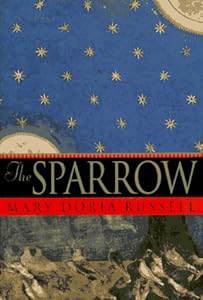
What I'm Reading Now-The Sparrow

The Sparrow by Mary Doria Russell-Two weeks ago, in a bit of a mini review, I said, "Right now, I am about half-way through, and I am dreading finding out what happens because this is one of those books that lets you know right up front that Things Did Not Go Well, and already I love the people involved and I so want things to go well for them, but I know that they don't, and it is heartbreaking." Well, kids, it remains heartbreaking, right through to the very end.

First, let me say, I loved this book. This is one of those books that makes other books pale in comparison, only I didn't realize it at the time (more on this when I post my review of The Gargoyle). I added this title to my TBR list four years (four years!) ago, and I am so glad that I finally decided to read it.

You get a sense of foreboding right from the start. The Prologue reads, in part:

The Jesuit scientists went to learn, not to proselytize. They went so that they might come to know and love God's other children. They went for the reason Jesuits have always gone to the farthest frontiers of human exploration. They went ad majorem Dei gloriam: for the greater glory of God. [That's beautiful. What a noble mission!]


They meant no harm. [Oh dear.]

Like I said, you know up front that Things Did Not Go Well. In 2021, eight people embark on a mission to Rakhat, a planet in the Alpha Centauri system, to investigate the source of the musical broadcasts that have been discovered emanating from that system. The mission is funded by the Jesuit Society and consists of four Jesuits and four civilians.

In 2059, Father Emilio Sandoz, the only surviving member of the party, is released from hospital, still physically and mentally ravaged from his mission, and moved to a Jesuit residence. Here he will be asked to explain what happened during the mission, to tell what happened to the other members of the party, and to explain the reports from the rescue party that paint him as a whore and a murderer.

The story bounces back between the "present day" in 2059/2060, and the time period between 2016 and...2042(?), from the time that the extraterrestrial music is discovered to the time Emilio Sandoz is rescued and taken off of Rakhat.

I don't even know what else to say about this book. I loved it so much. I don't want to say anything to make you not read it, and I want to say everything I can to make you read it, and then I don't want anybody to read it and not love it.

This is sci-fi, but what I would consider sci-fi lite. It's a story about cultural exploration, it just happens to be in another solar system. Yes, there is space travel and crazy, other-worldly creatures, and they have weird names, but it's not over the top, and I never felt overwhelmed by the foreign-ness of it all.

Speaking of foreign-ness, Emilio Sandoz grew up in the slums of Puerto Rico, and is not exactly what you might consider a traditional candidate for the priesthood. He grew up fighting and selling drugs and ended up in parochial school as a way to avoid jail. He surprised himself by liking certain aspects of his religious life and, although faith and prayer were never his strong suits, he entered the novitiate at age seventeen. He acknowledged his weaknesses and continued to pray, taking comfort in the words of his mentor, D.W. Yarbrough, who told him, 'Son, sometimes it's enough just to act less like a shithead.' And by that kindly if inelegant standard, Emilio Sandoz could believe himself to be a man of God.

Emilio is an extremely skilled linguist, and this comes in quite handy when the Jesuits are looking for someone to make contact with our new celestial neighbors. Throughout his life as a priest, Emilio remains agnostic, and as the mission begins to take shape he finally starts to think that perhaps there is something to this God thing. At one point, he sits down to talk to his good friend and shipmate, Anne, about what is going on in his head. There were a million things that had to go just right for everyone to come together as a part of this mission, and beyond all reasonable hope, they did.

So. Things kept happening, just like God was really there, making it all happen. And I heard myself saying Deus vult, [God wills it] like Marc, but it still seemed like some kind of huge joke. And then one night, I just let myself consider the possibility that this is what it seems to be. That something extraordinary is happening. That God has something in mind for me. Besides sewer lines, I mean...And a lot of the time, even now, I think I must be a lunatic and this whole thing is crazy. But sometimes--Anne, there are times when I can let myself believe, and when I do," he said, voice dropping to a whisper and his hands, resting on his knees, opening, as though to reach for something, "it's amazing. Inside me, everything makes sense, everything I've done, everything that ever happened to me--it was all leading up to this, to where we are right now. But, Anne, it's frightening and I don't know why..."


She waited to see if he had more but when he fell silent, she decided to take a shot in the dark. "You know what's the most terrifying thing about admitting that you're in love?" she asked him. "You are just naked. You put yourself in harm's way and you lay down all your defenses. No clothes, no weapons. Nowhere to hide. Completely vulnerable. The only thing that makes it tolerable is to believe the other person loves you back and that you can trust him not to hurt you."


He looked at her, astounded. "Yes. Exactly. That's how it feels, when I let myself believe. Like I am falling in love and like I am naked before God. And it is terrifying, as you say. But it has started to feel like I am being rude and ungrateful, do you understand? To keep on doubting. That God loves me. Personally." He snorted, half in disbelief and half in astonishment, and put his hands over his mouth for a moment and then pulled them away. "Does that sound arrogant? Or just crazy? To think that God loves me."

As the mission unfolds, Emilio begins to see more and more of the proof he has been searching for for so long. He finally believes, he knows that God is out there and that he has a plan for everybody and that his life's work has led him to this place in his life where he can finally fulfill God's plan. This is what he was put on Earth, given life, to do. He has finally, completely, accepted God and God's love. And then things go terribly, terribly wrong. When all the terrible details of the mission have finally been revealed in Emilio's 2060 debriefing, Father John Candotti utters a horrified, "My God," and Emilio responds:

Do you think so, John? Was it your God?" he asked with terrifying gentleness. "You see, that is my dilemma. Because if I was led by God to love God, step by step, as it seemed, if I accept that the beauty and the rapture were real and true, then the rest of it was God's will too, and that, gentlemen, is cause for bitterness. But if I am simply a deluded ape who took a lot of old folktales far too seriously, then I brought all this on myself and my companions and the whole business becomes farcical, doesn't it. The problem with atheism, I find, under these circumstances," he continued with academic exactitude, each word etched on the air with acid, "is that I have no one to despise but myself. If, however, I choose to believe that God is vicious then at least I have the solace of hating God."

Emilio's journey from doubt to belief to shattered faith is both heart-warming and harrowing, and despite all the doom and gloom I did actually feel like this book ended on a hopeful note. A tiny, quiet, whimpering note, but a hopeful one no less. I did have one issue with this book, but I feel like it's a bit of a spoiler to talk about it, not like it will make the book not worth reading or anything, but you know. So, don't read between the stars if you don't want to know what happened.

**********************************************************************************
Okay, so the thing, THE event that finally totally shattered Emilio's faith. I understand why it had that effect on him, but the fact of the matter is, he's not the only person who's ever been raped. Granted, he's probably the only person to ever experience it in that manner, but people, good, God-fearing people, are raped left and right on Earth every day. Why did it take it happening to Emilio to make him question God so? He's a compassionate man, and, growing up and then working in the area that he did, I'm sure he was no stranger to tales of rape. Why would a God that allows that to happen to His people on Earth be any less deplorable to Emilio than one who allows it to happen to Emilio? Did anyone else have an issue with this? If so, were you able to come to any good resolution?
**********************************************************************************

Okay, well, I'd love to hear from anyone else who has read this. I'd especially like to hear how it affected people of different beliefs. It's probably no secret to anyone who is familiar with my blog that I'm pretty definitely agnostic. I think it's just as big a leap of faith to claim with 100% certainty that there is no God as it is to declare with 100% certainty that there is a God, and, quite frankly, I just don't know. This book did not help clear things up one little bit, but it did make me feel, deeply, and that's why I loved it.

Other reviews:

Chris at Rude Cactus (It's only a one-liner, but it still gets the point across. Yeah, I know, I could take a lesson.)
Ann and Michael at Books on the Nightstand talk about The Sparrow in their podcast. Review starts around 4:57.

Have you reviewed The Sparrow? Let me know and I'll add a link to your review.


Saturday, June 13, 2009

What I'm Reading Now-The Thirteenth Tale

Cover to the first editionImage via Wikipedia
The Thirteenth Tale by Diane Setterfield-I LOVED this book. I enjoyed the story, but what sucked me in was the writing. I'm not someone who usually pays that much attention to writing style-as long as the story is good I don't really care too much about the writing as long as it isn't terrible-but I loved the writing in this book. I can't even define what it is that I liked, I just know I liked it. Part of it was that the author was able to capture so perfectly things that I have thought or felt before but never would have been able to accurately explain to someone else myself, but it was more than that. You can't just agree with someone else's descriptions for 400-some-odd pages and call that love. This is a book that I couldn't wait to get back to, to disappear back into the story every chance I had.

The story takes place in England amongst family-owned bookstores, richly furnished libraries, and country estates. What's not to love so far? The extremely popular but reclusive author, Vida Winter, has requested that Margaret Lea, a reclusive biographer in her own right, come to her home to write her biography. This is a first for Margaret, who is used to writing only about dead people, and for Miss Winter's fans. Over the years many writers have asked Miss Winter for her story, and they have all walked away with something, but never the truth. This changes when Margaret is summoned to Miss Winter's estate and Miss Winter finally tells her story, a story about twin girls, Adeline and Emmeline, who grew up under the neglectful eye of their mother and uncle (father/uncle?) and in the care of their well-meaning but mostly impotent housekeeper. They were a world unto themselves, each one half of a whole but a whole that wasn't quite....right. Eventually their childhood home burns to the ground, but who these girls are and the events leading up to the fire make for a mesmerizing story.

As Margaret prepares for her work with Miss Winter she decides to familiarize herself with some of Miss Winter's work. The effect that Miss Winter's work has on her is described in the following passage:

Of course one always hopes for something special when one reads an author one hasn't read before, and Miss Winter's books gave me the same thrill I had when I discovered the Landier diaries, for instance. But it was more than that. I have always been a reader; I have read at every stage of my life, and there has never been a time when reading was not my greatest joy. And yet I cannot pretend that the reading I have done in my adult years matches in its impact on my soul the reading I did as a child. I still believe in stories. I still forget myself when I am in the middle of a good book. Yet it is not the same. Books are, for me, it must be said, the most important thing; what I cannot forget is that there was a time when they were at once more banal and more essential than that. When I was a child, books were everything. And so there is in me, always, a nostalgic yearning for the lost pleasure of books. It is not a yearning that one ever expects to be fulfilled. And during this time, these days when I read all day and half the night, when I slept under a counterpane strewn with books, when my sleep was black and dreamless and passed in a flash and I woke to read again-the lost joys of reading returned to me. Miss Winter restored to me the virginal qualities of the novice reader, and then with her stories she ravished me. (p. 32)

Like Margaret I have been a reader all of my life, whether I was reading myself or someone else was reading to me is irrelevant. I can't remember my life without books. I can't imagine my life without books, and then, wow, that bit at the end!

There are so many things that I want to quote for you from this book, but I don't want this post to get too long, and/or I don't know if they'll do justice to the book all on their own-they're mainly pieces that I could relate to, as I was saying at the beginning of this post, but not much to do with the story itself, so please don't let that throw you. That said...

Margaret and Miss Winter have sat down for one of their sessions, but Margaret is distracted. That description in and of itself is enough for most of us to understand; we've all been there, our thoughts are elsewhere, we've got other things on our mind, but I love the way that Setterfield describes this phenomenon:

All morning I struggled with the sensation of stray wisps of one world seeping through the cracks of another. Do you know the feeling when you start reading a new book before the membrane of the last one has had time to close behind you? You leave the previous book with ideas and themes-characters even-caught in the fibers of your clothes, and when you open the new book, they are still with you. Well, it was like that. All day I had been prey to distractions. Thoughts, memories, feelings, irrelevant fragments of my own life, playing havoc with my concentration.

Miss Winter was telling me about something when she interrupted herself. "Are you listening to me, Miss Lea?"

I jerked out of my reverie and fumbled for an answer. Had I been listening? I had no idea. At that moment I couldn't have told her what she had been saying, though I'm sure that somewhere in my mind there was a place where it was all recorded. But at the point when she jerked me out of myself, I was in a kind of no-man's-land, a place between places. The mind plays all sorts of tricks, gets up to all kinds of things while we ourselves are slumbering in a white zone that looks for all the world like inattention to the onlooker. (p. 289-290)

Boy, have I ever been there before. In fact, I seem to find myself there more and more frequently these days. At the current moment I'm a little distracted because I keep drifting back to something that needs to be said, but that I don't want to have to say, and I need to find exactly the right time and place to say it or it won't get said, but it needs to be said. Again, Setterfield finds a way to describe this that is so spot on:

His confidences, this mist, had led us unexpectedly onto a peninsula of intimacy, and I found myself on the brink of telling what I had never told anyone before. The words flew ready-formed into my head, organized themselves instantly into sentences, long strings of sentences, bursting with impatience to fly from my tongue. As if they had spent years planning for this moment.

"I believe you," I repeated, my tongue thick with all the waiting words. "I've had that feeling, too. Knowing things you can't know. From before you can remember."

And there it was again! A sudden movement in the corner of my eye, there and gone in the same instant.

"Did you see that, Aurelius?"

He followed my gaze to the topiary pyramids and beyond. "See what? No, I didn't see anything."

It had gone. Or else it had never been there at all.

I turned back to Aurelius, but I had lost my nerve. The moment for confidences was gone. (p.220-221)
Augh! Don't you hate it when that happens? How many times have you put off having a conversation, asking a question, revealing a secret for hours, days, even years, because the time just wasn't quite right?

One more. Remember the not-quite-right twins? Well, here is a great moment of revelation as to their character. The housekeeper Mrs. Dunne (the Missus) is listening to them talk to each other in their made-up twin language when:

The shock of understanding froze her there in the doorway. And as sometimes happens, one illumination opened the door to another. The clock on the mantelpiece chimed and, as always, the mechanism under glass sent a little bird out of a cage to flap a mechanical circuit before reentering the cage on the other side. As soon as the girls heard the first chime, they looked up at the clock. Two pairs of wide green eyes watched, unblinking, as the bird labored around the inside of the bell, wings up, wings down, wings up, wings down.

There was nothing particularly cold, particularly inhuman about their gaze. It was just the way children look at inanimate moving objects. But it froze the Missus to the core. For it was exactly the same as the way they looked at her, when she scolded, chided or exhorted.

They don't realize that I am alive, she thought. They don't know that anyone is alive but themselves. (p.83)

Yeah, good luck with those two, Missus. Remember how I talked about kids that make me happy? These are not those kids. These kids? They give me the heebie-jeebies.

Anyway, I loved this book. I didn't expect to like it that much, but I finally gave in and mooched it because of all the buzz about it, but I thought it would be entertaining and that would be about it. I was wrong.

Other reviews:

Nymeth at Things Mean a Lot (who also has links to tons of other reviews)

And for a slightly different take (caution: spoilers)
30 Great Books

If you've read this book, I'd like to hear what you thought about it. Did you review it? Let me know, and I'll add your review.

(BTW, do you like my giant graphic? I've been experimenting with Zemanta, and that is what it gave me.)

Monday, June 8, 2009

What I'm Reading Now-The Hunger Games

I've been doing a lot of reading lately, and I am pretty behind on my reviews. If you keep an eye on my Goodreads widget in my sidebar at all, you may notice books coming and going in the "recently read" category with no corresponding reviews here and be thinking, Hey, what's the deal? If you really are dying to know what I thought about the book, you can click over to my Goodreads account and see (just click on the bar under the book shelf that says goodreads). I may not have a written review, but you can at least see how many stars I gave each book. It's not that I'm suffering from illusions of grandeur, thinking that everyone is waiting with bated breath to hear what I thought of something before they read it; but I know it's frustrating to see something you're interested in listed as "recently read" and then not be able to find a corresponding review.

So, anyway, on with the review!

The Hunger Games by Suzanne Collins-I have been hearing nothing but good things about this book, so I was excited when it was picked for our last book club book. It was an easy read, and while I wouldn't say I loved it as much as some of my fellow bloggers, I wasn't disappointed either. It did keep me interested and wanting to see how everything was going to be resolved, and I definitely think this is one that will stick with me for a while.

For those who haven't heard about this yet (where have you been??) the novel takes place in a North America where there has been an uprising against the Capitol. The Capitol prevailed and now the 12 outlying districts are forced to participate in the annual Hunger Games. The reasons for the Hunger Games are twofold; entertainment for those in the Capitol and punishment for the districts' uprising.

Every year, each district has to send two children, one boy and one girl between the ages of twelve and eighteen, to participate in The Hunger Games. The children are all thrown together into a manufactured outdoor arena and they have to fight to the death until there is only one child left. All of this is televised nationwide a la current-day reality TV. The winner and his or her district receive valuable prizes, including things like shelter and food, and of course, bragging rights. The Capitol plays up the bragging rights part, the poor districts are a little more excited about the food part, not so much about the our-kids-might-die part.

In District 12, twelve-year-old Prim's name is drawn for participation in this year's Hunger Games. Her sister, sixteen-year-old Katniss, knows there is no way she will survive and steps up to take her place. Since the death of her father, Katniss has been hunting illegally to provide for her family and knows that she has a much better chance of survival. The boy from District 12 is a baker's son who once provided a tremendous kindness to Katniss even though they didn't know each other, so right away, you know there's going to be emotional turmoil. If one of them makes it back, it's going to be because the other is dead.

I really enjoyed this book even though I'd have to stop about every three pages and say, "This is SO MESSED UP!" Reading about Katniss and her strategies throughout the game was interesting. I kept wanting to know what she was going to do next, how she was going to survive, what obstacles she would have to face. The other thing that really got to me about this book was her relationship with her sister. You don't really get a feel for their relationship with each other so much, but you do see Katniss's protective nature and the way she does all she can to keep her sister safe and try to protect her from the bad things in life. That really hit home for me because I have a little sister who is eight years younger than me, and I could really relate to a lot of the things that Katniss was dealing with on that level.

This is a YA book, but obviously there are some pretty heavy themes here, and it is pretty graphic. It doesn't gloss over the fact that the object of the game is to survive and the only way to do that is to kill other children. Given the subject matter, I don't think it goes too extreme, but it doesn't evade the issue either.

By the end of the book, the major story line has been resolved, but the reader is still left wondering, What happens now?? Luckily for us, the sequel, Catching Fire is now out. My bad. Thanks to farmlanebooks for correcting me. This doesn't come out until September 1. I think I will have to read it in the near future when it comes out!


Other reviews:

Books on the Nightstand-Ann (Listen to the Podcast-Ann's review is about 7:20, but listen to the whole podcast if you get a chance)

Now that I've linked to all these reviews, I'm trying to figure out why my response to this book wasn't quite as strong as everyone else's. I pretty much agree with everything everyone else has said, but I just didn't have the same "OMG, I couldn't put this book down!!" response. Maybe you guys can help me out. If you've read The Hunger Games and LOVED it, why? What about this book in particular made it so great for you? Was it the characters? Was it the horror of the Games? Was it that it hits close to home, or was it just all of these things coming together to form the perfect story, or was it something else altogher?